

BIM Coordination
The Contractual Playbook of BIM Project BIM Management Plan vs. BIM Execution Plan
BIM projects need more than models—they need clear governance. This chapter explains how the Project BIM Management Plan establishes the project-wide vision, while BIM Execution Plans translate that vision into practical workflows, responsibilities, standards, and quality-control procedures.
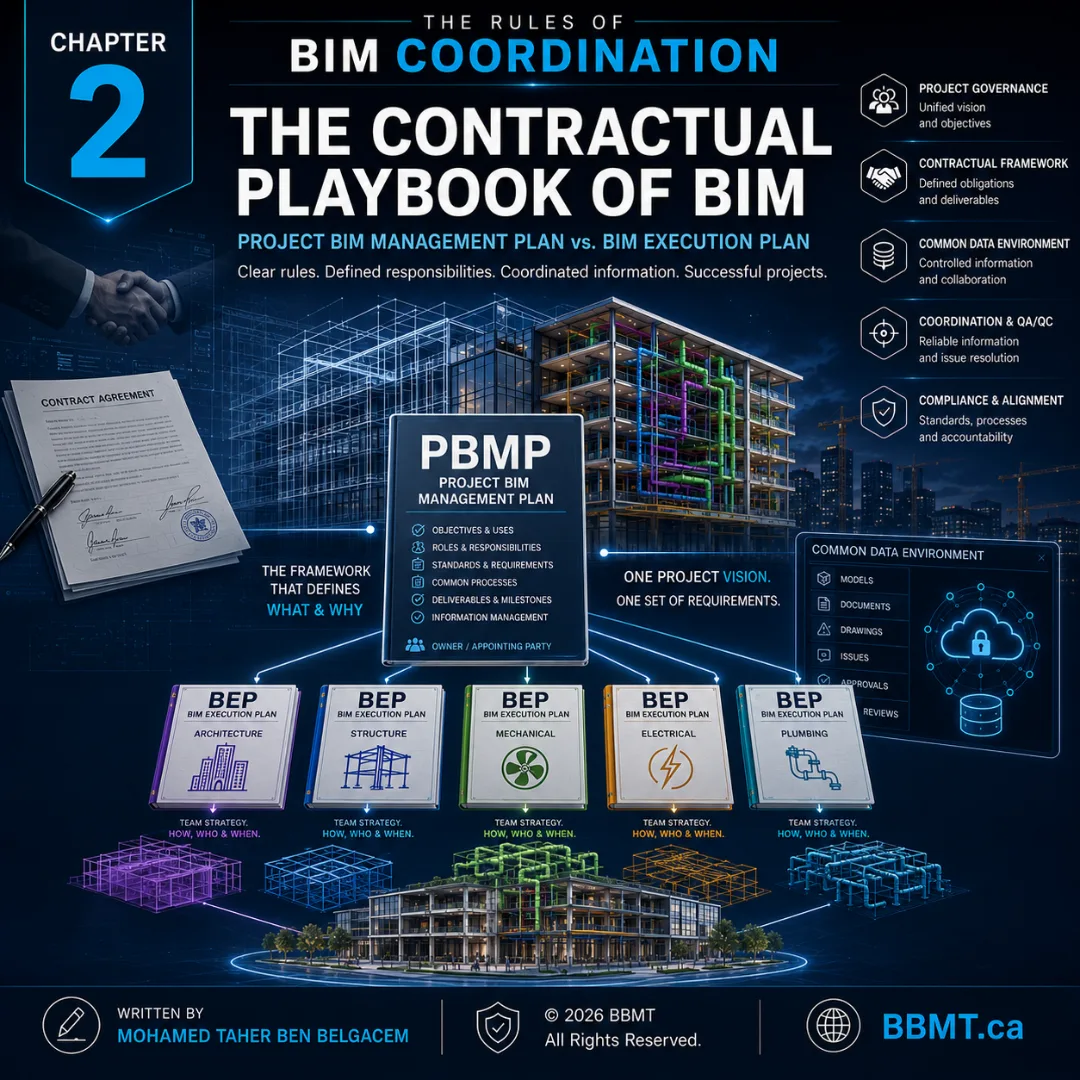
Chapter 2: The Contractual Playbook of BIM
Project BIM Management Plan vs. BIM Execution Plan
Traditional construction projects are governed through contracts, specifications, schedules, and two-dimensional drawings. When a project adopts Building Information Modeling, however, additional questions must be answered.
Who is responsible for modeling each system? Which software versions will be used? How frequently will models be exchanged? Which coordinate system governs the project? Who reviews the information before it is shared? How are coordination issues assigned, tracked, and closed?
These questions cannot be answered by software alone. They require a structured BIM governance framework.
For clarity, this chapter uses two English terms:
The Project BIM Management Plan, or PBMP, establishes the project-wide BIM vision, requirements, responsibilities, and common rules.
The BIM Execution Plan, or BEP, explains how each delivery team or discipline will satisfy those requirements in practice.
The exact document names may vary between clients and jurisdictions. However, the underlying distinction remains the same:
The PBMP defines the project-wide framework.
The BEP defines how the work will be executed.
Understanding the relationship between these two documents is one of the keys to a successful BIM project kickoff.
1. The Terminology Maze: ISO 19650, Canada, and Project-Specific Language
BIM terminology can become confusing because different countries, organizations, and clients use different names for documents that perform similar functions.
Despite the variety of acronyms, most BIM governance documents answer two fundamental questions:
What information does the project require?
How will the delivery teams produce, review, coordinate, and deliver that information?
Under the ISO 19650 information-management framework, the appointing party defines its information requirements. These requirements explain what information must be delivered, when it must be delivered, and how it will support project or asset-management objectives.
The delivery teams then prepare a BIM Execution Plan, commonly abbreviated as BEP, explaining how they intend to satisfy those requirements.
The term Exchange Information Requirements, or EIR, is commonly used for requirements associated with specific information exchanges and delivery milestones.
Across Canada, some organizations use terms such as:
BIM Protocol
BIM Execution Plan
Project Execution Plan
Project BIM Plan
Project BIM Management Plan
A Project Execution Plan, often abbreviated as PxP, may cover the broader project-delivery strategy rather than BIM alone. Depending on the client, BIM requirements may be incorporated into the PxP or documented separately.
For this chapter, the terminology is organized into two practical levels:
LevelPrimary QuestionDocumentProject-wide governanceWhat are the project’s BIM objectives, requirements, standards, responsibilities, and common processes?Project BIM Management Plan — PBMPTeam or discipline executionHow will each team organize its work to satisfy those requirements?BIM Execution Plan — BEP
These documents may overlap with other project protocols, information requirements, and execution plans. They should not automatically be treated as exact equivalents across every organization.
The definitions written into the project’s procurement and contract documents always take priority.
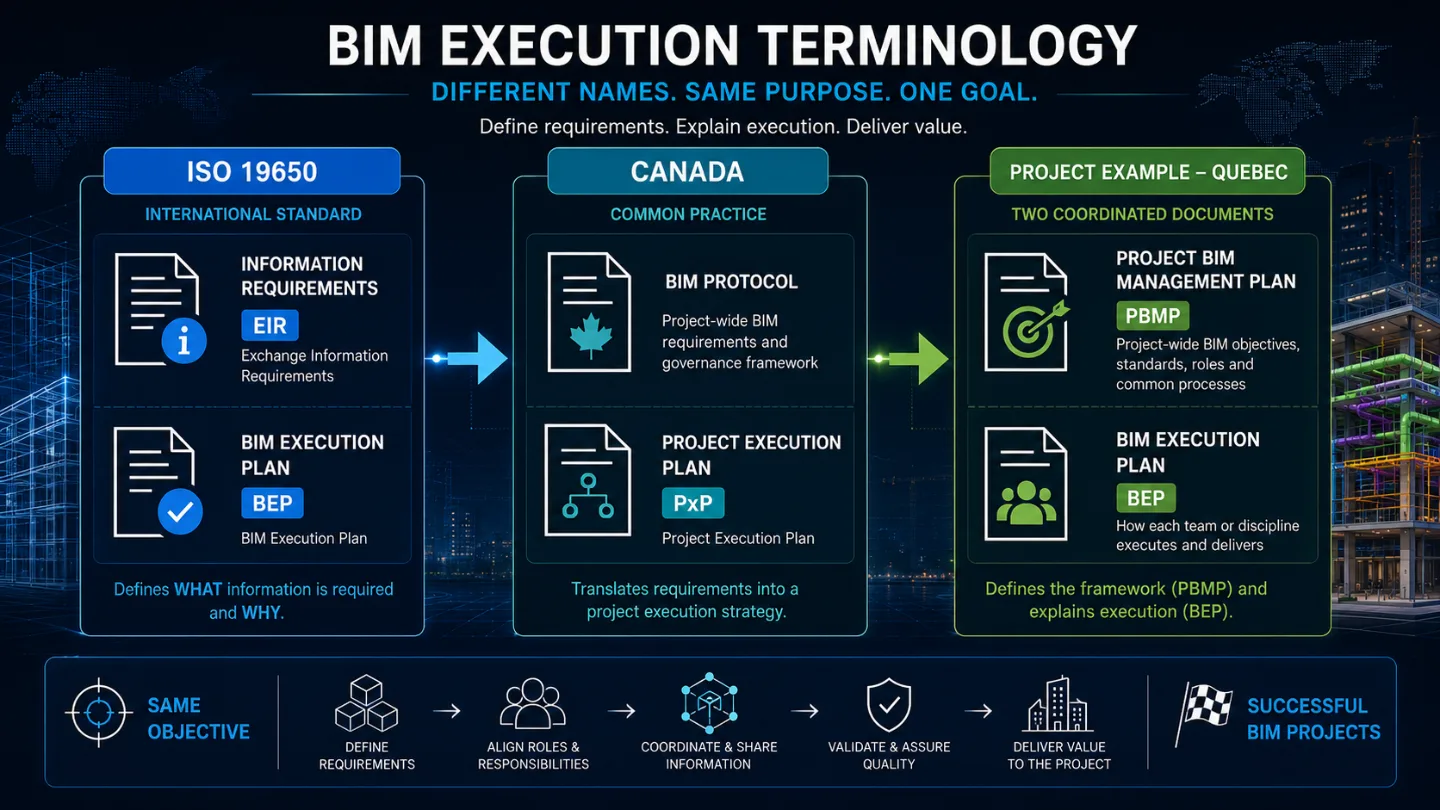
The important lesson is not to memorize every acronym. The project team must identify:
Which document defines the requirements
Which document defines the execution strategy
Which requirements are contractually binding
Which document takes priority when information conflicts
2. The Project BIM Management Plan: The Owner’s Vision and Global Rules
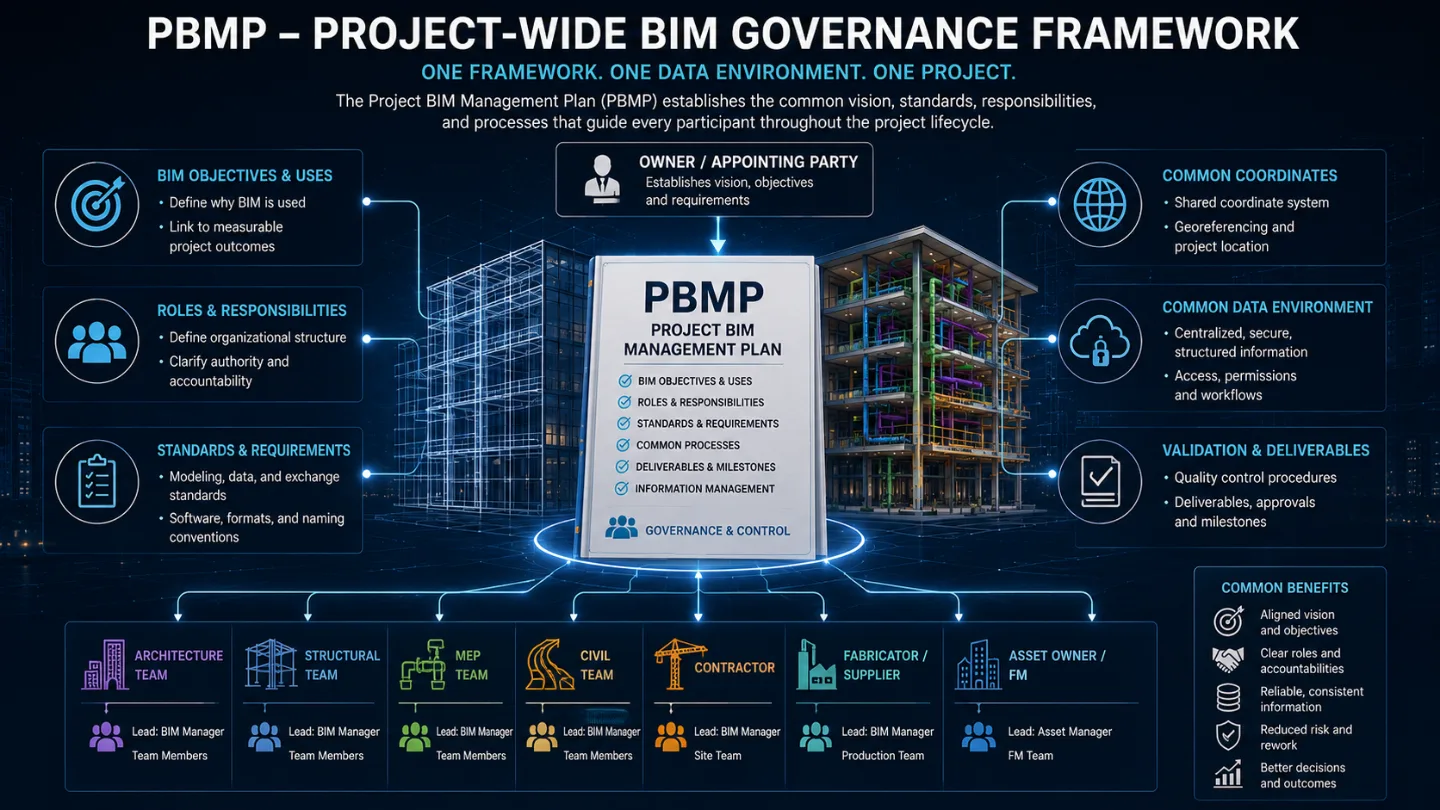
The Project BIM Management Plan is the project’s central BIM governance document.
It can be understood as the project’s BIM constitution.
The PBMP is generally prepared, commissioned, or approved by the owner, appointing party, lead BIM manager, or information-management authority. It is introduced early in the project and establishes the common framework that all appointed participants must follow.
Its primary purpose is to create a shared understanding of the project’s:
BIM objectives
Information requirements
Roles and responsibilities
Technical standards
Coordination procedures
Deliverables
Approval processes
Information-management rules
Without a project-wide management plan, each discipline may establish an effective internal workflow while still remaining incompatible with the wider project.
For example:
The architectural team may use one coordinate origin while the structural team uses another.
One consultant may exchange models weekly while another submits only at major milestones.
Teams may use incompatible software versions.
File names and folder structures may differ between disciplines.
Participants may interpret model-development requirements differently.
One team may consider a model ready for coordination while another considers it incomplete.
The PBMP prevents these inconsistencies by defining the common rules before detailed production begins.
What Is Included in a Project BIM Management Plan?
A well-structured PBMP should address the following areas.
The Why: BIM Objectives and Uses
The PBMP explains why BIM is being used and what the owner expects to achieve.
Possible BIM objectives include:
Multidisciplinary model coordination
Clash detection and issue resolution
Quantity extraction and cost planning
Construction sequencing
Energy and performance analysis
Digital fabrication and prefabrication
Site logistics planning
Record-model delivery
Facility and asset-management information
Digital-twin preparation
BIM uses should be connected to measurable project outcomes.
A project should not require a process simply because it is considered a standard BIM activity. Each requirement should support a defined project, operational, or business objective.
The Who: Roles, Responsibilities, and Authority
The PBMP identifies the principal BIM participants and defines their responsibilities.
These may include:
Owner or appointing party
Project BIM director
Lead BIM manager
Information manager
Discipline BIM managers
BIM coordinators
Model authors
General contractor
Fabricators
Trade contractors
Asset-management representatives
A responsibility matrix should clarify who:
Creates the information
Reviews the information
Approves the information
Authorizes it for use
Coordinates issues
Maintains the Common Data Environment
Is accountable when requirements are not satisfied
Clear responsibility prevents important tasks from being duplicated, overlooked, or assigned informally.
The What: Standards and Information Requirements
The PBMP defines the project’s common technical requirements.
These may include:
Shared coordinate and georeferencing systems
Model breakdown and federation strategy
Classification systems
File-naming conventions
Folder structures
Required software versions
Approved exchange formats
Model-development requirements
Information requirements
Common Data Environment procedures
Model-sharing frequency
Coordination and issue-management workflows
Quality-control requirements
Data-security rules
Access permissions
Model-approval procedures
The PBMP should clearly distinguish between recommended practices and mandatory requirements.
The When: Milestones and Deliverables
The PBMP establishes when information must be:
Produced
Internally reviewed
Shared
Coordinated
Approved
Published
Archived
Delivered to the owner
These milestones should align with the project schedule, procurement strategy, construction sequence, and contractual deliverables.
Is the Project BIM Management Plan Contractually Binding?
The legal status of a BIM management plan depends on how it is incorporated into the project agreements.
Some organizations treat the document as a contractually binding requirement. Others use it primarily as a procedural guide while stating that the main professional-services or construction agreement takes priority.
Both approaches are possible.
A PBMP may become contractually binding when it is:
Attached to the signed agreement
Incorporated into the contract by reference
Included in the request for proposals
Identified as a required contractual deliverable
Included in the contract’s order-of-precedence clause
To reduce risk, the document should clearly state:
Whether it creates contractual obligations
Which contract document takes priority in the event of a conflict
Who has authority to revise it
How revisions are reviewed and approved
How changes are communicated
How superseded versions are archived
The objective is not simply to label the document as contractual. The objective is to eliminate ambiguity before the project team begins relying on it.
3. The BIM Execution Plan: The Delivery Team’s Field Manual
If the Project BIM Management Plan is the project’s constitution, the BIM Execution Plan is the delivery team’s tactical playbook.
The PBMP defines the common destination.
The BEP explains how the delivery team intends to reach it.
A BEP is normally prepared by a discipline BIM manager, BIM coordinator, information manager, technical lead, or delivery-team representative with direct knowledge of the production workflow.
Depending on the project structure, separate execution plans may be prepared for:
Architecture
Structure
Mechanical systems
Electrical systems
Plumbing systems
Civil works
Fabrication
Construction coordination
Trade contractors
A project may also use one combined BEP covering the entire delivery team, supported by discipline-specific procedures.
The structure should reflect the actual project organization.
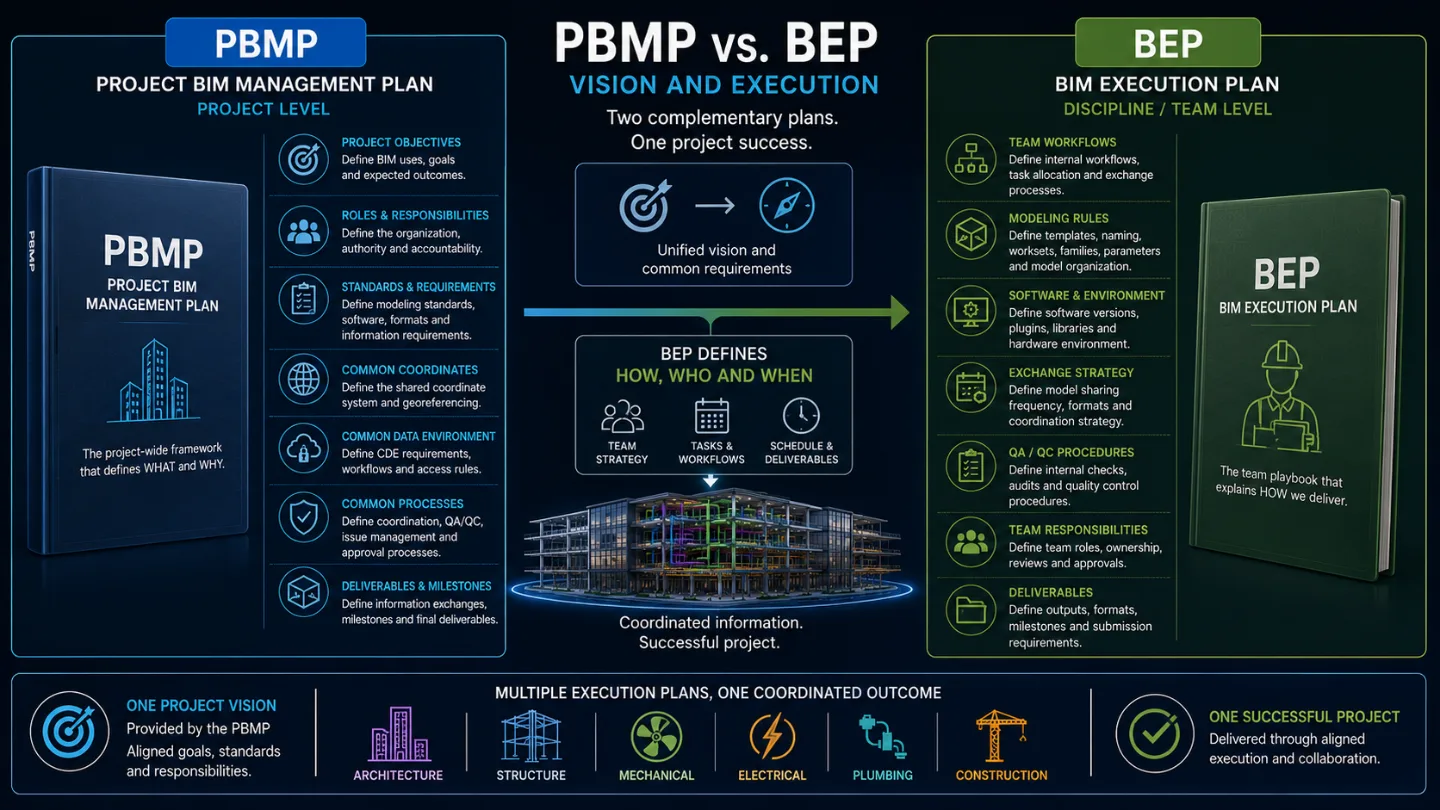
Project BIM Management Plan — PBMPBIM Execution Plan — BEPApplies to the entire projectApplies to a delivery team or disciplineDefines the common BIM visionDefines the execution strategyEstablishes project-wide objectivesTranslates objectives into practical tasksDefines shared standardsExplains how the team will complyIdentifies high-level rolesAssigns detailed team responsibilitiesEstablishes common processesDocuments internal workflowsDefines required deliverablesExplains how deliverables will be producedDefines validation expectationsEstablishes internal quality-control proceduresUsually led by the owner or lead BIM authorityUsually prepared by the delivery team’s BIM lead
The Operational Test of a Strong BEP
A BIM Execution Plan should never be a generic document copied from a previous project without meaningful revision.
A useful BEP should pass two operational tests:
Does it clearly explain the actual day-to-day workflow of this specific delivery team?
Can a newly assigned model author read it and understand how to produce compliant information?
A strong BEP should help a new team member answer questions such as:
Which model or file should I open?
Which template should I use?
Where should the file be stored?
How should the file be named?
Which coordinates, grids, and levels govern the model?
Which elements am I responsible for?
Which classifications and parameters are required?
How often must the model be synchronized or shared?
Which checks must be completed before information is issued?
Who reviews my work?
How are coordination issues assigned and closed?
Which file formats and export settings must be used?
If the document cannot answer these practical questions, it may be too theoretical to guide production.
What Is Included in a BIM Execution Plan?
Team Workflows
The BEP explains how the team organizes its internal work.
This may include:
Task allocation
Model ownership
Internal review stages
Model-sharing schedules
Coordination-meeting preparation
Issue-assignment procedures
Revision workflows
Approval workflows
Communication channels
Escalation procedures
Modeling Rules
The BEP documents the team’s specific production standards.
These may include:
Project templates
File and folder organization
Model segmentation
Naming conventions
Family or object nomenclature
Workset organization
View and sheet standards
Classification requirements
Parameter requirements
Model-development requirements
Model-authoring responsibilities
The BEP should explain exactly how the project-wide standards will be applied within the team’s authoring environment.
Software and Technical Environment
The BEP identifies the technical systems used by the team.
This may include:
Exact software versions
Approved updates
Required plug-ins
Export configurations
Shared content libraries
Hardware requirements
Cloud or server locations
Synchronization procedures
Backup procedures
Model-access permissions
Defining software versions is particularly important. Incompatible versions can prevent teams from opening, linking, reviewing, or correctly exchanging project information.
Quality Assurance and Quality Control
The BEP defines the internal checks that must occur before information leaves the delivery team.
Typical controls include:
Model-health reviews
Duplicate-element checks
Warning reviews
Coordinate verification
File-naming checks
Parameter-completeness checks
Classification validation
Interference reviews
File-size optimization
Model-cleaning procedures
Export verification
Deliverable checklists
Visual inspection
Approval records

The BEP transforms quality control from an informal personal habit into a repeatable team process.
4. The Lifecycle: From Tender to Handover
The Project BIM Management Plan and BIM Execution Plan should not appear only after modeling has already begun.
They develop through the project’s procurement, appointment, mobilization, delivery, and handover stages.
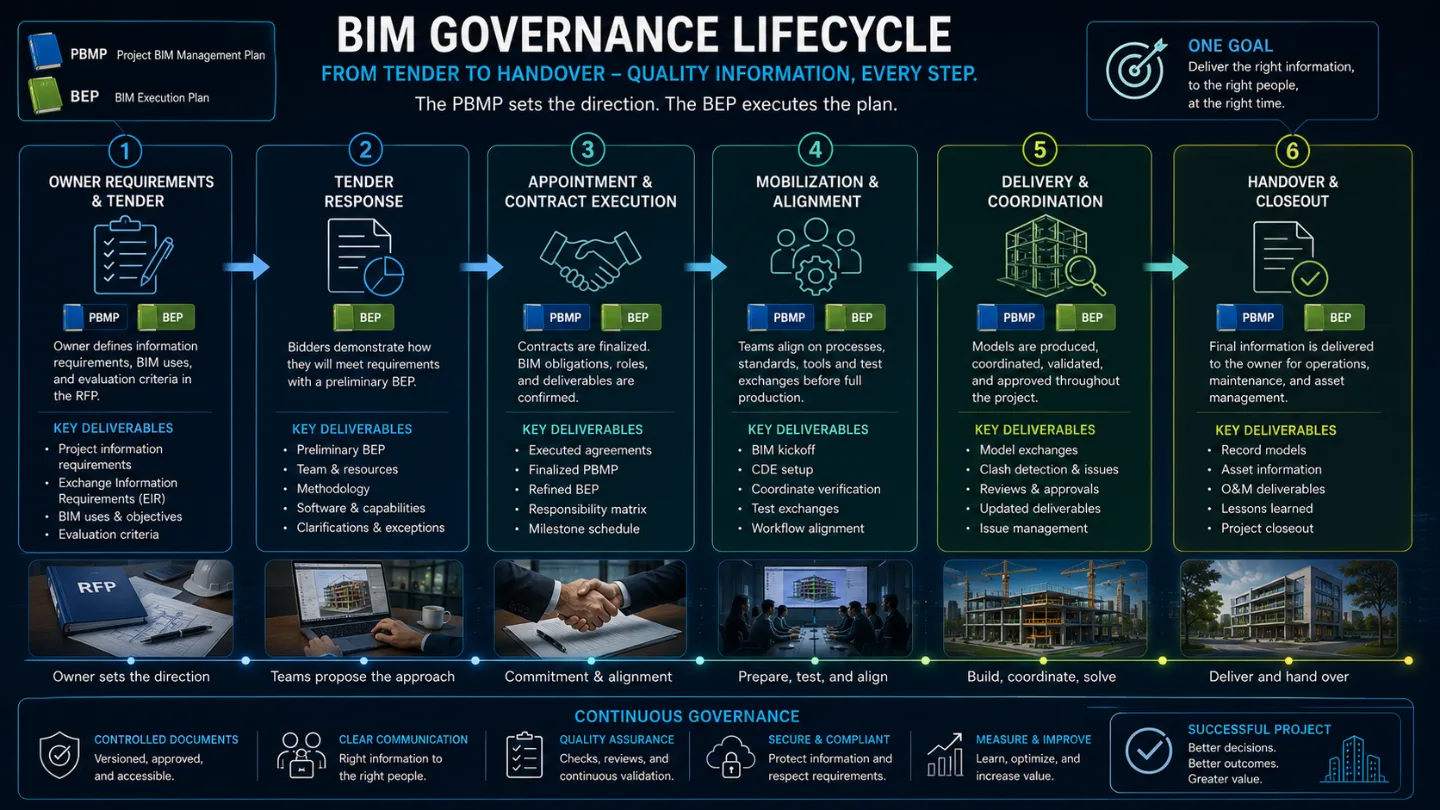
Stage 1: Owner Requirements and Invitation to Tender
The owner or appointing party defines the project’s information requirements.
The request for proposals may include:
Initial project BIM requirements
Exchange Information Requirements
BIM uses and objectives
Required deliverables
Software and format requirements
Coordination expectations
Common Data Environment requirements
Tender-evaluation criteria
At this stage, the owner explains what the project expects from the successful delivery teams.
Stage 2: Tender Response
The bidding teams explain how they intend to meet the requirements.
Their response may include a preliminary or pre-appointment BEP describing:
Proposed team structure
BIM experience and qualifications
Available resources
Software capabilities
Coordination methods
Quality-control approach
Anticipated risks
Proposed exceptions
Required clarifications
The purpose is to demonstrate that the bidder understands the project requirements and has a credible execution strategy.
Stage 3: Appointment and Contract Execution
Once the successful participants are selected, the agreements are finalized.
The project team confirms:
Contractual BIM obligations
Roles and responsibilities
Deliverable milestones
Model ownership
Information-security requirements
Approval procedures
Document precedence
Change-management procedures
The selected delivery teams then refine their preliminary execution plans.
Stage 4: Mobilization and Alignment
Before full production begins, the lead BIM authority and delivery teams align the PBMP and BEP documents.
This stage may include:
BIM kickoff meetings
Coordinate verification
Model-federation tests
Software compatibility tests
Common Data Environment setup
Naming and folder reviews
Sample model exchanges
Clash-detection tests
Responsibility-matrix confirmation
Approval-workflow testing
The objective is to identify workflow incompatibilities before they affect live project information.
Stage 5: Delivery, Coordination, and Handover
During project delivery, the PBMP and BEP guide:
Model production
Information exchange
Coordination
Validation
Approval
Publication
Issue management
Final delivery
Both documents should be treated as controlled, living documents.
When project conditions change, the documents may need to be updated. However, revisions should not occur informally.
Each change should be:
Reviewed
Approved
Versioned
Communicated
Recorded
Archived
At handover, the documents also help verify that the final models and information satisfy the owner’s requirements.
Conclusion: Two Documents, One Goal
A successful BIM project cannot rely on a Project BIM Management Plan alone.
Without team-level execution plans, the project-wide requirements may remain too general to guide the people performing the daily work.
A project cannot rely only on separate BIM Execution Plans either.
Without a unified project-wide framework, each discipline may create an effective internal process while using different coordinates, standards, file structures, software versions, and delivery assumptions.
The two documents must work together:
The Project BIM Management Plan provides the unified project vision.
The BIM Execution Plans provide the precise operational strategy.
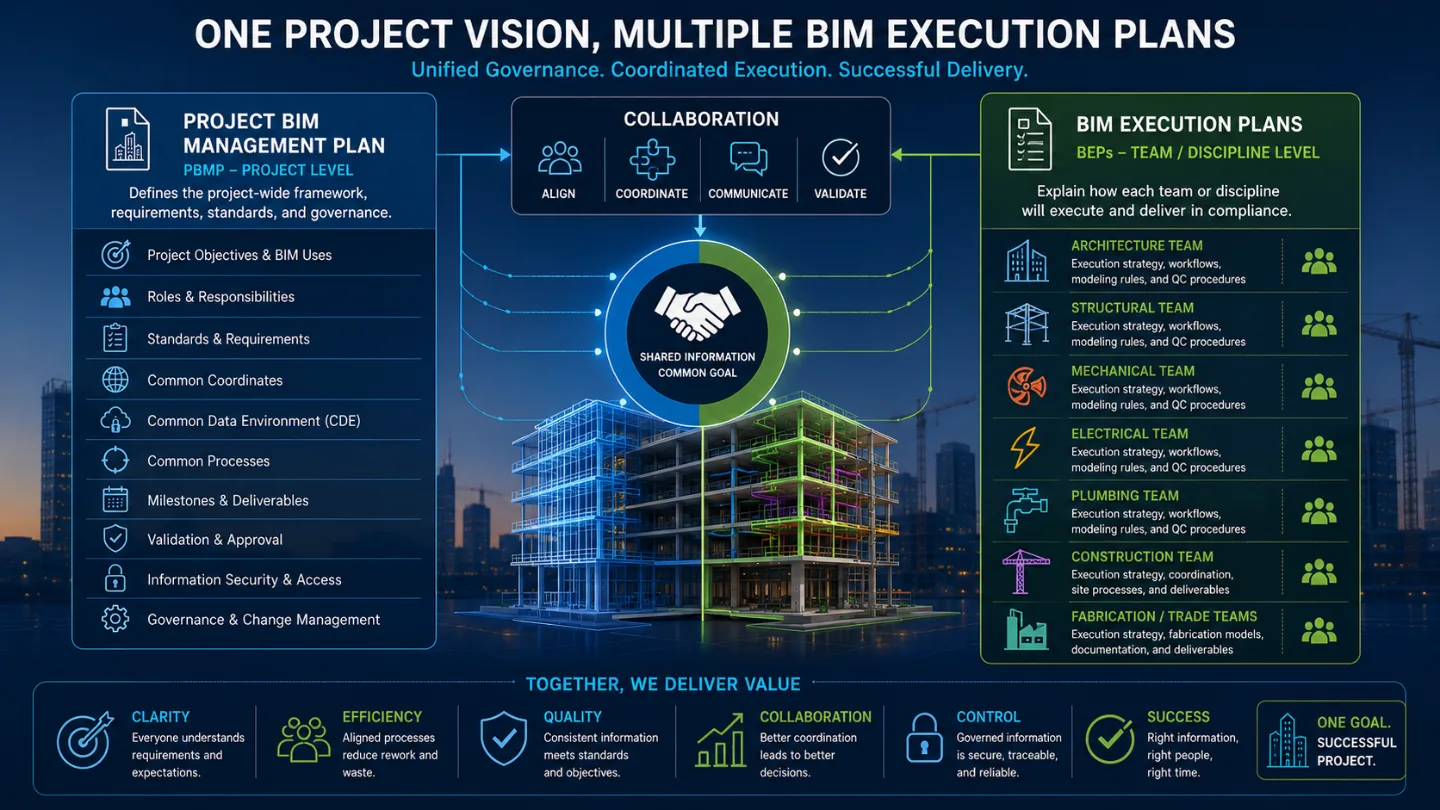
When the PBMP and BEPs are aligned, BIM becomes more than a collection of three-dimensional models.
It becomes a controlled project-delivery system in which every participant understands:
What information must be produced
Why the information is required
Who is responsible for producing it
How it must be created
When it must be exchanged
Who must review and approve it
How it contributes to the project’s final objectives