
BIM Coordination
The Core Mindset and Human Engine of BIM Coordination
Successful BIM coordination begins with people, processes, and shared responsibility—not software alone. This chapter explains how federated models, Common Data Environments, and clearly defined BIM roles help multidisciplinary teams identify conflicts earlier, protect project information, and coordinate construction more effectively.
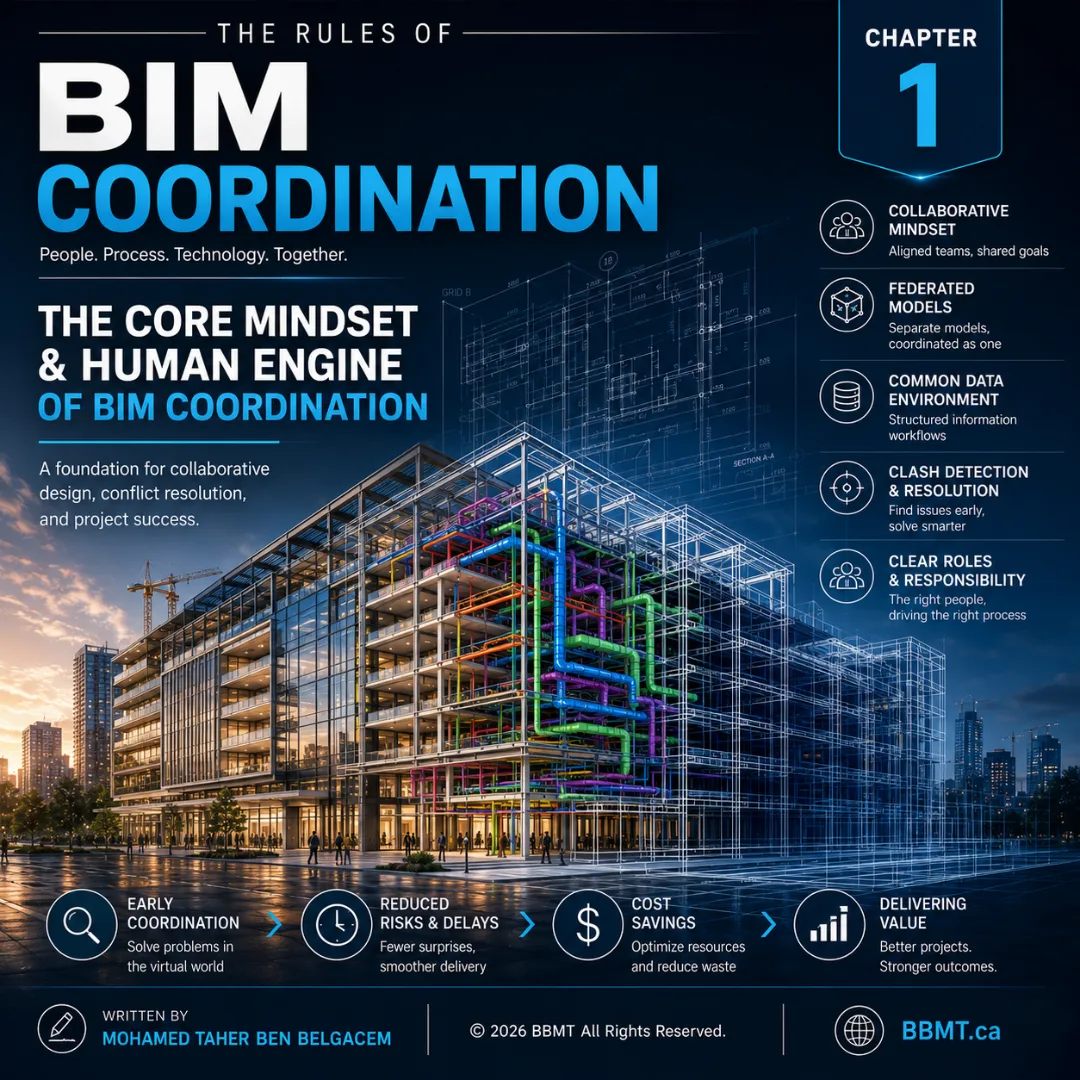
Chapter 1: The Core Mindset and Human Engine of BIM Coordination
The construction industry has long faced a costly paradox: architects, structural engineers, and mechanical, electrical, and plumbing specialists must work together to create a single physical building, yet their designs have historically been developed in separate and isolated two-dimensional environments.
This disconnect is where coordination errors develop, schedules begin to slip, and project costs increase.
Modern construction addresses this problem through collaborative BIM coordination. However, successful coordination is not achieved simply by purchasing expensive software. It requires a fundamental change in how project teams communicate, exchange information, manage responsibilities, and resolve design conflicts.
1. The Silent Cost of Silos: Traditional 2D Workflows vs. BIM Collaboration
In a traditional design workflow, coordination can resemble a high-stakes game of telephone. Drawings are revised, exported, renamed, emailed, reviewed, marked up, and redistributed between the different project participants.
Each discipline may be working from a different version of the project information. Architectural plans may not reflect the latest structural changes, while mechanical layouts may have been developed without access to recently modified ceiling heights or beam locations.
Because the files are flat and disconnected, identifying conflicts depends heavily on manual comparison and human interpretation.
BIM coordination changes this process.
Each discipline continues to develop and control its own specialized model, but those models are exchanged regularly within a shared collaborative framework. The architectural, structural, mechanical, electrical, plumbing, and construction models can then be reviewed together.
This continuous exchange allows teams to detect clashes and inconsistencies in a virtual environment long before those problems reach the construction site.
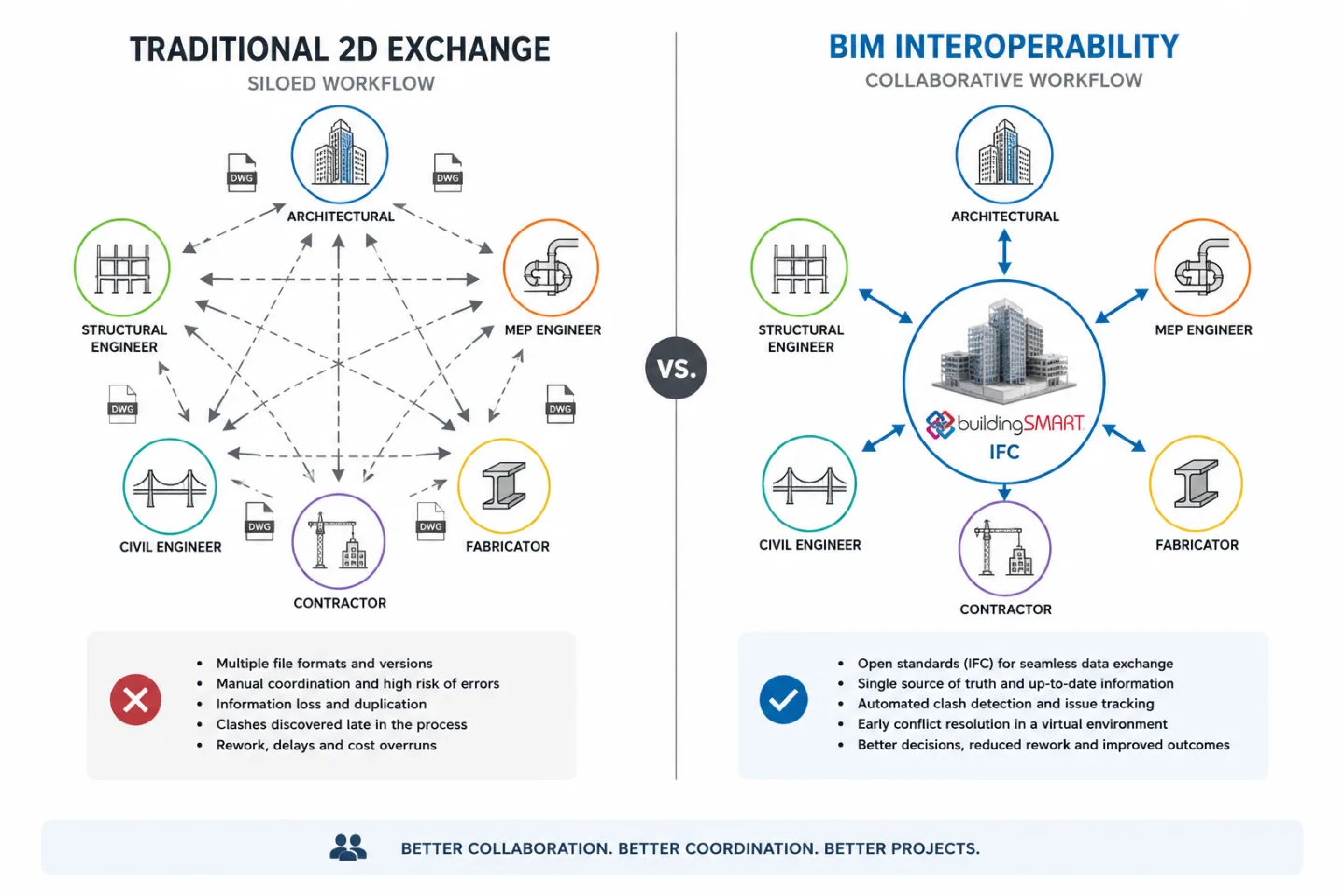
The difference is not simply visual. BIM interoperability creates a more structured communication system. Instead of sending disconnected information in every direction, each discipline contributes its model to a coordinated environment using agreed standards and exchange formats such as IFC.
This helps project teams maintain ownership of their information while still making it available for interdisciplinary review.
Moving Coordination Earlier
One of the greatest benefits of BIM is the ability to shift coordination efforts toward the beginning of the project.
During the early design stages, the project team has greater flexibility to influence the design, construction strategy, materials, systems, and overall project cost. At the same time, the cost of making a change is relatively low.
As the project progresses toward documentation and construction, the ability to influence the final result decreases while the cost of changes increases significantly.
A duct rerouted during virtual coordination may require only a few minutes of modeling. The same conflict discovered after installation could require demolition, replacement materials, additional labor, schedule changes, and coordination with several trades.
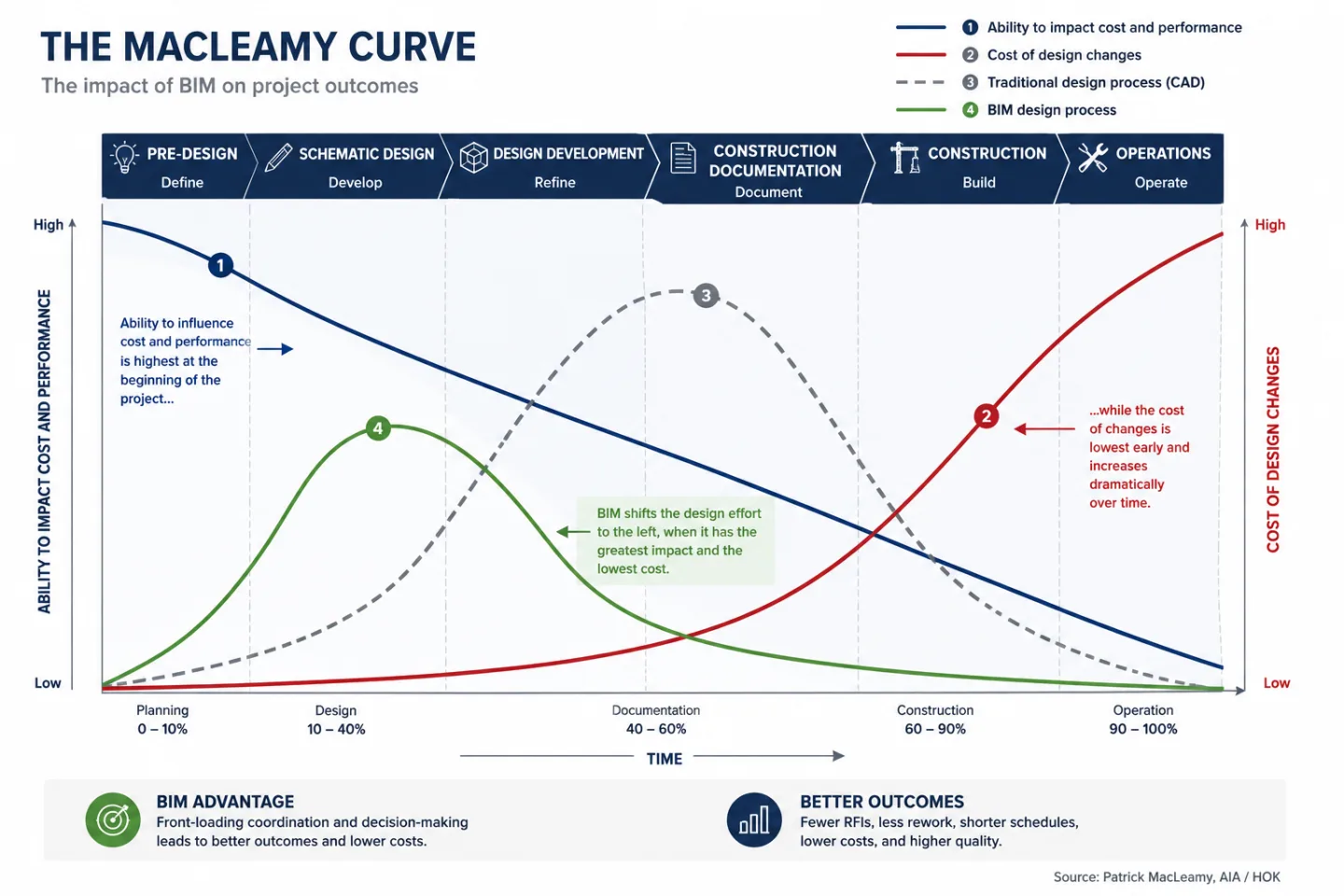
The MacLeamy curve illustrates this principle by showing how BIM shifts design and coordination effort toward the earlier phases of a project.
This front-loaded approach does not necessarily reduce the total amount of work. Instead, it places the work at the stage where decisions are easier, less expensive, and more valuable.
2. The Federated Model: Federation vs. Integration
At the center of collaborative BIM coordination is the federated model.
The terms “integrated model” and “federated model” are sometimes used interchangeably, but they represent different approaches.
Integrated Model
An integrated model combines project information into a single model or database where multiple participants may work simultaneously.
Although this approach can be effective in certain environments, it can become difficult to manage when project participants use different authoring platforms, file formats, modeling standards, or internal workflows.
It can also create uncertainty regarding model ownership and responsibility.
Federated Model
A federated model is a centralized coordination environment that superimposes separate discipline models without permanently merging or modifying their original source information.
It can be understood as a coordinated digital overlay.
The architect remains responsible for the architectural model. The structural engineer owns the structural model. The mechanical team owns the ductwork and equipment. The electrical team controls its systems, and the plumbing team maintains its piping information.
When these models are loaded into the federated environment, they are positioned together using an agreed coordinate and georeferencing system.
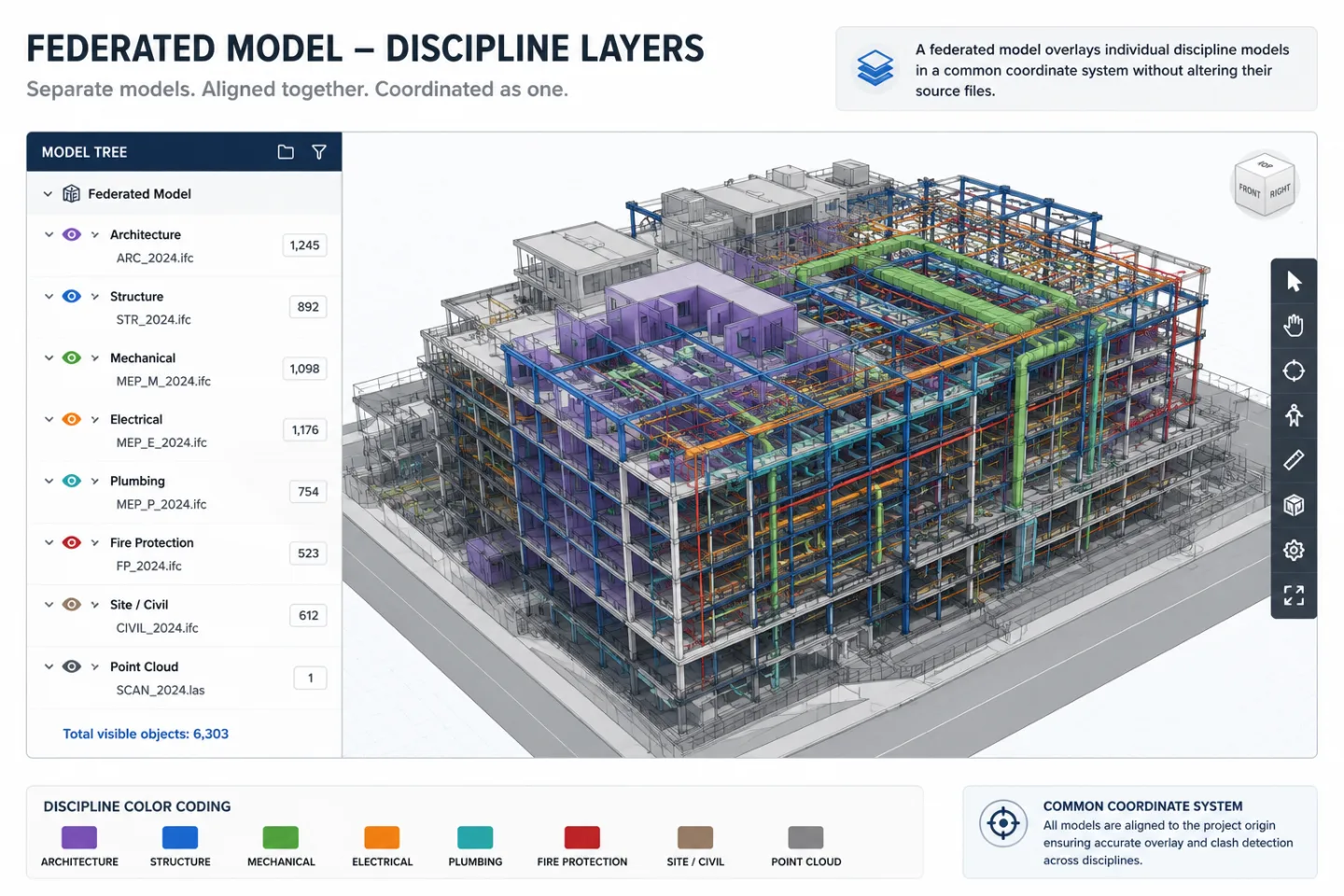
The federated model allows the project team to see how the different systems interact while preserving the independence and responsibility of each source model.
A typical federated model may include:
Architectural models
Structural models
Mechanical models
Electrical models
Plumbing models
Civil and site models
Fabrication models
Construction sequencing models
Point clouds and existing-condition information
The federated model should not become an uncontrolled collection of files. Model names, revisions, coordinates, classifications, and exchange dates must follow agreed project standards.
The Common Data Environment
To keep this ecosystem organized, project information moves through a structured lifecycle within a Common Data Environment, commonly referred to as a CDE.
A CDE provides a controlled location for collecting, managing, reviewing, sharing, publishing, and archiving project information.
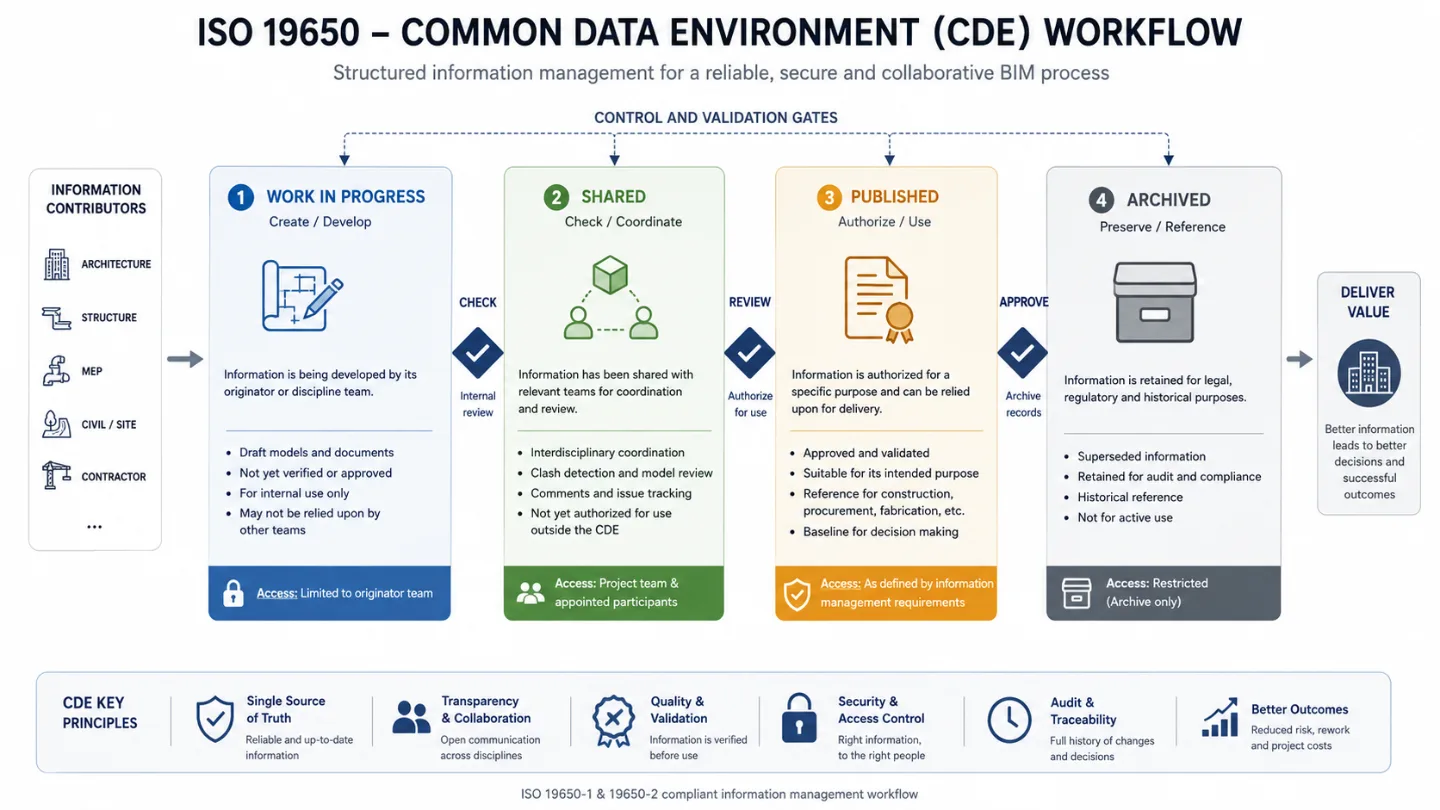
A simplified CDE workflow contains four principal information states:
Work in Progress
Information is still being developed by its originating discipline. It has not yet been approved for use by the wider project team.
Shared
Information has passed an internal review and is available for coordination, consultation, and interdisciplinary review.
Published
Information has been reviewed, authorized, and approved for a defined project purpose, such as construction, fabrication, procurement, or formal client delivery.
Archived
Superseded or historical project information is retained for traceability, auditing, and future reference.
Control and validation gates between these states help prevent incomplete, outdated, or unauthorized information from being used for critical project decisions.
3. The Human Engine: Who Does What?
A federated model is only as effective as the people managing and contributing to it.
Collaborative modeling brings together participants with different technical backgrounds, contractual responsibilities, software knowledge, and project objectives. Clearly defined roles are therefore essential.
Without role clarity, teams may duplicate work, overlook important checks, modify information they do not own, or assume that another participant is responsible for resolving an issue.
The human engine of BIM coordination can be organized into three primary levels:
STRATEGIC
BIM Director or Lead BIM Manager
↓
COORDINATION
BIM Coordinator
↓
PRODUCTION
BIM Modeler or Model Author
I. The Strategic Leader: BIM Director or Lead BIM Manager
The BIM Director or Lead BIM Manager is the strategic anchor of the project or organization.
This role establishes the overall BIM framework and ensures that technology, information management, and project processes support the client’s objectives.
Typical responsibilities include:
Defining the BIM strategy
Preparing or overseeing the BIM Execution Plan
Establishing project standards and procedures
Defining information exchange requirements
Coordinating contractual BIM obligations
Managing legal and information ownership considerations
Establishing quality assurance procedures
Selecting or approving platforms and collaboration systems
Aligning BIM processes with business and project objectives
Supporting training and organizational capability development
The BIM Manager’s responsibility extends beyond the technical model. The role focuses on governance, risk, compliance, contractual requirements, and the long-term reliability of the project’s information.
II. The Interface: BIM Coordinator
The BIM Coordinator is the practical engine of the coordination process.
Typically an engineer, technologist, designer, or experienced technical specialist, the BIM Coordinator acts as the interface between the different project disciplines.
The Coordinator may not create all the project data, but they review, combine, audit, and coordinate the models.
Typical responsibilities include:
Collecting and federating discipline models
Verifying model positioning and coordinates
Reviewing file naming and model structure
Checking compliance with modeling standards
Performing clash detection tests
Identifying model quality issues
Managing coordination issues and their status
Preparing coordination reports
Organizing and facilitating coordination meetings
Assigning issues to the responsible disciplines
Following up on unresolved conflicts
Confirming that corrections appear in subsequent model revisions
The BIM Coordinator turns standards and project requirements into practical actions.
A clash detection report alone does not constitute coordination. The Coordinator must interpret the results, eliminate irrelevant clashes, identify the responsible participants, establish priorities, communicate the problem clearly, and verify that the agreed solution is implemented.
III. The Creator: BIM Modeler or Model Author
The BIM Modeler is the hands-on creator of the project information.
Modelers use authoring platforms such as Revit, Cadwork, Tekla Structures, Archicad, Civil 3D, or specialized fabrication software to create the physical and informational components of the project.
Typical responsibilities include:
Modeling walls, floors, columns, beams, pipes, ducts, equipment, and other components
Creating and maintaining parametric families or objects
Following the project’s modeling standards
Applying the required classifications and parameters
Maintaining an organized project library
Correcting issues assigned during coordination
Respecting model ownership and discipline boundaries
Producing drawings and schedules from the model
Delivering information at the required Level of Development or Level of Information Need
Modelers are responsible for the quality of the information they create. A visually accurate model is not sufficient if its elements are incorrectly classified, poorly structured, duplicated, misplaced, or missing required data.
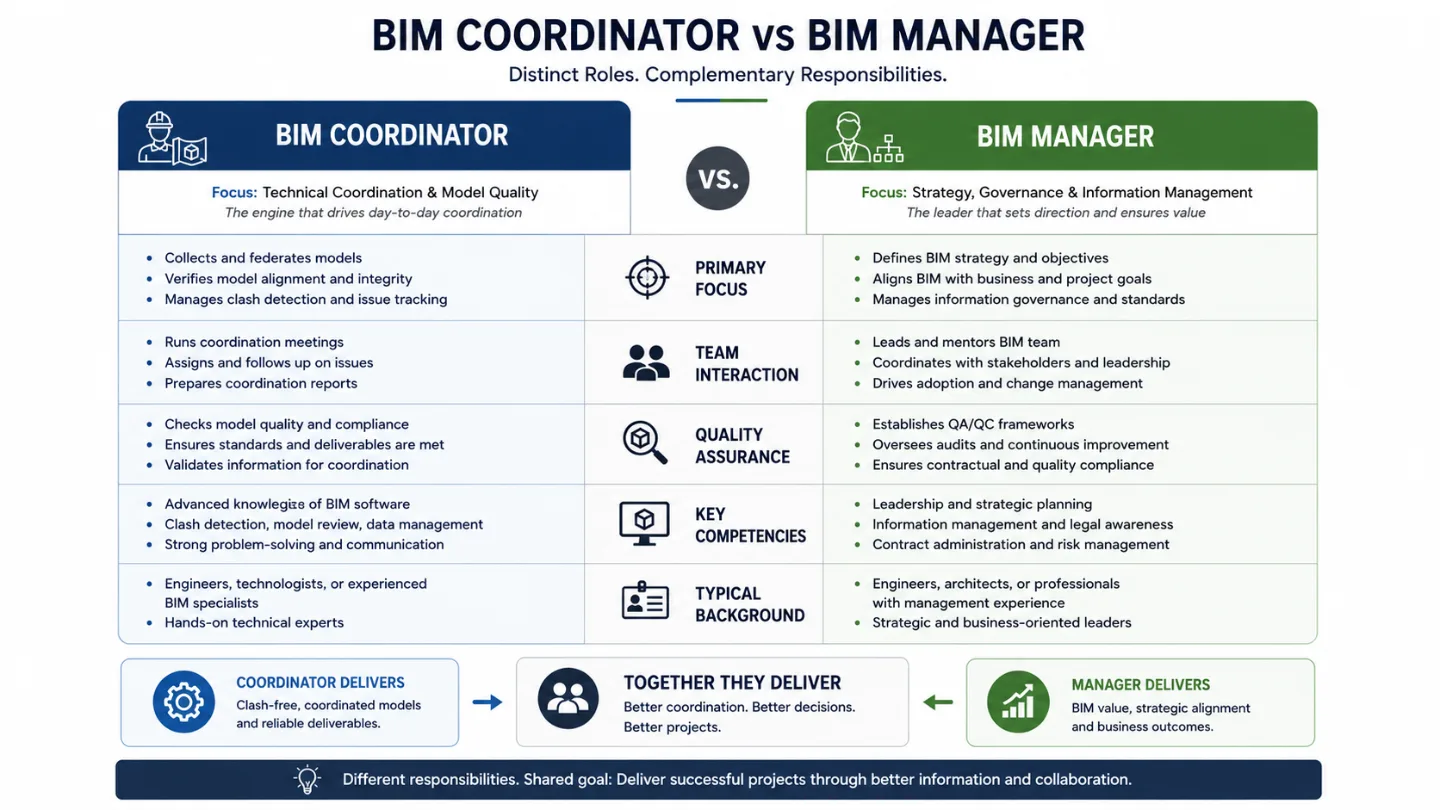
The BIM Coordinator and BIM Manager therefore have complementary responsibilities.
The Coordinator’s focus is generally closer to technical delivery, model quality, federation, clash detection, synchronization, and issue resolution.
The BIM Manager’s focus is generally closer to project strategy, information governance, contractual requirements, risk management, standards, training, and organizational planning.
Both roles are necessary, but they operate at different levels of the BIM process.
4. Conclusion: 10% Technology, 90% Collaboration
BIM coordination tools are extremely powerful, but they remain facilitators.
Software can combine models, identify intersections, create reports, track issues, visualize construction sequences, and organize information. It cannot independently create trust, assign responsibility, encourage transparency, or persuade project participants to resolve a conflict.
True BIM coordination is a collaborative culture.
It succeeds when architects, engineers, technicians, fabricators, contractors, and owners agree to:
Work transparently
Follow shared standards
Exchange models regularly
Respect information ownership
Communicate changes clearly
Accept responsibility for their discipline
Resolve conflicts before construction
Treat the federated model as a shared decision-making environment
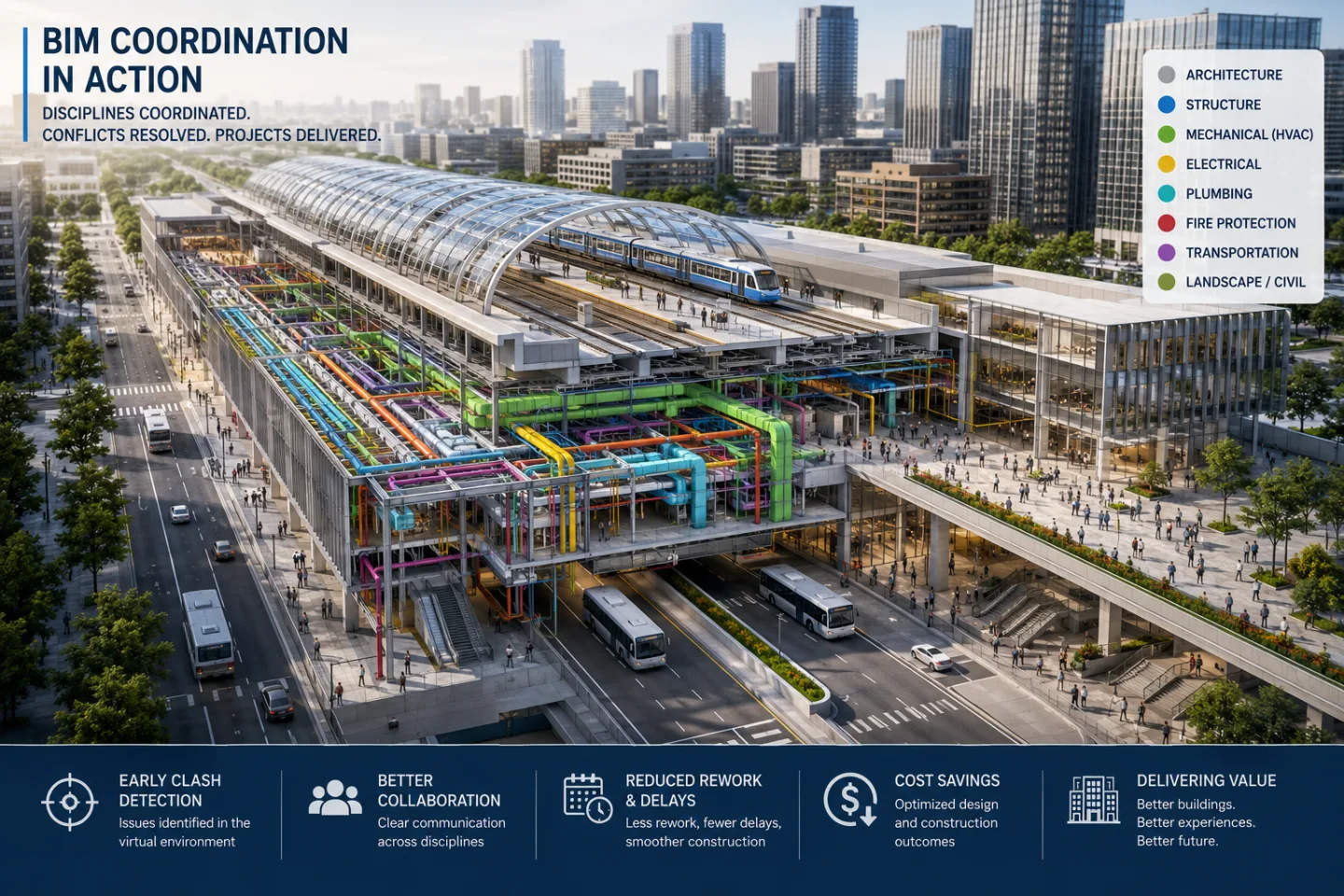
The final coordinated model is the visible result of an often invisible process: disciplined information management, regular communication, technical expertise, clearly defined responsibilities, and a shared commitment to solving problems before they reach the physical construction site.
The true value of BIM is not the three-dimensional model itself.
Its value lies in bringing people, information, and decisions together at the right time.